
Arjun is 22, lives in Pune, and has been lifting for five months. His bench press has stalled at 60 kg, and his trainer handed him the answer: “Take creatine. Load 20 grams a day for a week.” He ordered a tub online.
Two days later his mother found it on the kitchen shelf. “Is this a steroid? Beta, this will damage your kidneys.” His cousin, who lost his hair early, added over WhatsApp: “Creatine makes you bald, bro.” Arjun put the tub back in the box and searched: is creatine safe?
Arjun is a composite of the questions we hear most, but the family argument is very real. The good news is that creatine is one of the most researched supplements in sports nutrition, so each of these worries has an actual answer — not just opinions.
What creatine actually is
Creatine isn’t a drug or a hormone. It’s a small compound your liver, kidneys, and pancreas make every day — about 1 gram — from three amino acids (arginine, glycine, and methionine). Around 95% of it is stored in your muscles.
Its job is to recharge your muscles’ fastest energy source during short, hard efforts: a heavy set of squats, a sprint, a quick burst on the football field. More stored creatine means your muscles can keep that effort going for a little longer before they tire — often one or two extra reps.
You also get creatine from food, but only from meat and fish. A typical non-vegetarian diet provides roughly 1–2 g a day. A vegetarian diet provides almost none, which matters a lot in India.
| Source | Creatine |
|---|---|
| Your own body | ~1 g per day |
| Non-vegetarian diet (meat, chicken, fish) | ~1–2 g per day |
| Vegetarian or vegan diet | Close to zero |
| A typical supplement dose | 3–5 g per day |
What creatine does — and what it doesn’t
Creatine doesn’t build muscle by itself. It helps you train a little harder, and the extra training builds the muscle. Without lifting, it does very little.
| Claim | What the research says |
|---|---|
| More strength in the gym | Yes — small but consistent gains, especially in upper-body lifts |
| More muscle over time | Yes, alongside strength training. In older adults, about 1.4 kg more lean mass than training alone |
| Extra reps in repeated hard sets | Yes — its clearest effect |
| Better sprinting and team sports | Often, for short repeated bursts |
| Better long-distance running or swimming | Little to no effect |
| Burns fat | No |
| Works without training | Not meaningfully |
Think of it as a small multiplier on work you’re already doing. The foundation is still a good programme built on progressive overload and enough protein — see how much protein you need to build muscle.
Why vegetarians may benefit the most
Because vegetarian diets contain almost no creatine, vegetarians usually start with lower muscle creatine stores. In one controlled study, vegetarians who took creatine during eight weeks of weight training saw bigger increases in muscle creatine, lean mass, and total work than non-vegetarians taking the same supplement.
Creatine monohydrate is usually made synthetically, not from animals, so it generally suits vegetarians. If this matters to you, check the label: some capsule shells are made from gelatin, which is an animal product.
The myths, one by one
“It’s a steroid”
No. Anabolic steroids are synthetic versions of testosterone that act as hormones. Creatine is a nutrient your body already makes and stores, and it’s found in ordinary food. It isn’t a hormone, and it isn’t banned by the World Anti-Doping Agency.
“It will damage your kidneys”
This is the most common worry, and it mostly comes from a lab-test mix-up. Creatine naturally breaks down into creatinine, and doctors use blood creatinine to estimate how well your kidneys filter. Taking creatine can nudge creatinine up slightly — which looks like a kidney problem on paper even when the kidneys are fine.
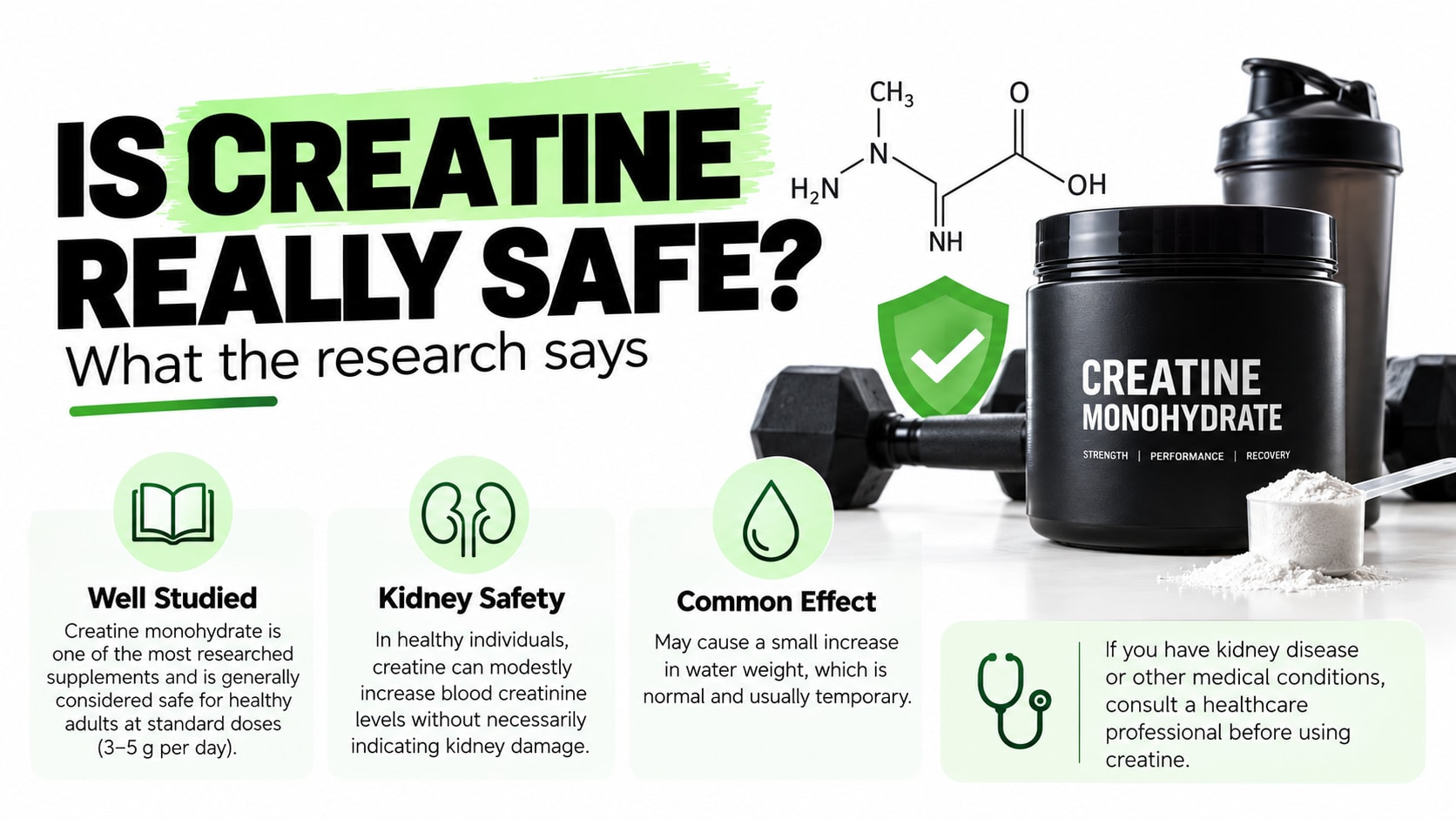
When researchers measure kidney function directly, the picture is reassuring. A 2019 systematic review and meta-analysis concluded that creatine supplementation did not cause kidney damage at the doses and durations studied, and position stands from sports-nutrition experts reach the same conclusion for healthy people.
The honest caveat: that evidence is in healthy people. If you already have kidney disease, reduced kidney function, or diabetes, or you regularly take medicines that affect the kidneys, don’t take creatine without your doctor’s advice. And always tell your doctor about it before a blood test.
“It makes you go bald”
This worry traces back to a single 2009 study of 20 rugby players. After a week of high-dose loading, their levels of DHT — a hormone linked with male-pattern hair loss — rose. But the study never looked at anyone’s hair, and the result hadn’t been repeated.
In 2025, researchers finally tested it directly. In a 12-week randomised controlled trial, young men took 5 g of creatine or a placebo each day. There were no differences in DHT, in the DHT-to-testosterone ratio, or in hair density, follicle count, or hair thickness.
If you’re genetically prone to hair loss, it will likely happen with or without creatine. If your hairline worries you, speak with a dermatologist — they have treatments that actually work.
“It makes you bloated and fat”
Creatine pulls water into your muscles, so the scale often rises by about 1–2 kg in the first week or two — more if you do a loading phase. That’s water inside the muscle, not fat under the skin, and many people find their muscles simply look a little fuller.
A “puffy” or bloated feeling usually comes from taking big doses at once. Staying at 3–5 g a day, or splitting a loading dose into smaller servings, largely avoids it.
“It causes cramps and dehydration”
Studies in athletes, including those training in the heat, haven’t found that creatine increases cramping, muscle injuries, or dehydration. You don’t need to drink gallons extra — just drink normally and follow your thirst, with a little more on hot days and training days. For a practical guide, see how much water you should drink.
“You have to load it and cycle it”
Neither is required. Loading just gets you to full stores faster; a steady daily dose gets you to the same place in a few weeks. And there’s no evidence you need to cycle creatine on and off — daily use is what the research supports.
How to take creatine
| Approach | How | Full muscles in |
|---|---|---|
| Simple daily dose (recommended) | 3–5 g once a day, every day | ~3–4 weeks |
| Loading phase | About 20 g a day, split into four 5 g doses, for 5–7 days — then 3–5 g a day | ~1 week |
- Choose creatine monohydrate. It’s the form used in almost all the research, and it’s usually the cheapest. Newer forms such as creatine HCl or ethyl ester haven’t been shown to work better.
- Take 3–5 g a day. Most people do well on 3–5 g; larger, very muscular people tend to use the higher end. Check your scoop size on the label — tubs often include a 3 g or 5 g scoop.
- Take it every day, including rest days. Timing isn’t important; consistency is.
- Mix it with anything — water, milk, curd, juice, or your protein shake. Taking it with a meal can help if your stomach is sensitive.
- Keep training and eating well. Creatine only helps if there’s hard training for it to support.
Pair it with a solid daily routine. Our beginner gym diet plan covers meals, and protein before or after a workout answers the timing question for protein too.
How to buy genuine creatine in India
Creatine itself is cheap and simple, but fake and mislabelled supplements are a real problem in India. A few checks go a long way:
- Buy from the brand’s official website or an authorised seller, not the cheapest random listing.
- Check for an FSSAI licence number on the pack, and for imported products, the importer’s details.
- Look for a single ingredient: creatine monohydrate. Avoid “proprietary blends” that hide the amount.
- Prefer third-party tested products or recognised raw materials, and brands that let you verify batches with a code or QR check.
- Choose unflavoured if you can — no added sugar or sweeteners, and easy to mix into anything.
Who should skip creatine or ask a doctor first
- People with kidney disease or reduced kidney function
- People with diabetes or high blood pressure that affects the kidneys
- Anyone taking medicines that affect the kidneys, including regular use of painkillers such as ibuprofen
- Pregnant, trying to conceive, or breastfeeding
- Under 18
- Anyone with a medical condition or on regular medication — check with your doctor or pharmacist first
If you notice anything unusual after starting — such as persistent stomach upset, swelling in the legs, or changes in how often you pass urine — stop and see a doctor.
What to expect, week by week
| When | What usually happens |
|---|---|
| Week 1 | Scale up by about 0.5–2 kg (water in the muscle). No big change in the gym yet, unless you loaded |
| Weeks 2–4 | Muscles are close to full. Many people notice an extra rep or two on hard sets |
| Months 2–3 | Small, steady strength gains add up; muscle gain slightly ahead of training alone |
| If you stop | Muscle creatine returns to normal over about 4–6 weeks; the water weight goes with it |
Keep your expectations realistic: creatine adds a little on top of good training. For honest timelines on muscle gain, see how long it takes to build muscle.
What happened to Arjun
Arjun didn’t load. He showed his mother the research, promised to tell his doctor at his next blood test, and bought unflavoured creatine monohydrate from an authorised seller. He took 3 g a day in his morning milk — on rest days too.
Three weeks in, the scale was 1.2 kg higher and his mother was convinced it was fat. By week eight his bench press had moved from 60 kg to 67.5 kg. Creatine didn’t do that alone: he also finally started tracking his lifts and eating enough protein — mostly dal, paneer, curd, and eggs (see our best high-protein Indian foods). But the extra rep or two on every hard set added up. And his hairline is exactly where it was.
Next step: Creatine works best alongside enough protein. Find your daily target with the protein calculator.
Key takeaways
- Creatine is a natural compound your body makes and stores in muscle — not a steroid or a hormone.
- Taken at 3–5 g a day with strength training, it helps you do more reps, get stronger, and gain a little more muscle.
- Research in healthy people hasn’t found kidney damage, and a 2025 trial found no effect on hair — but always tell your doctor before a blood test.
- Expect 1–2 kg of water weight in the muscle at first. Loading and cycling are optional.
- Buy plain creatine monohydrate from an authorised seller, and check with a doctor first if you have kidney problems, diabetes, are pregnant, or are under 18.
Supplements are the last 5%. Start with the foundation: how much protein to build muscle and progressive overload. This is educational information, not medical advice. Consult a qualified professional for personal health decisions.