
Protein in 50 Indian foods, ranked
Which everyday Indian foods give you the most protein? We ranked every food in our database three ways — per typical serving, per 100 calories and per 100 g — using the Indian Food Composition Tables 2017.
Quick answer
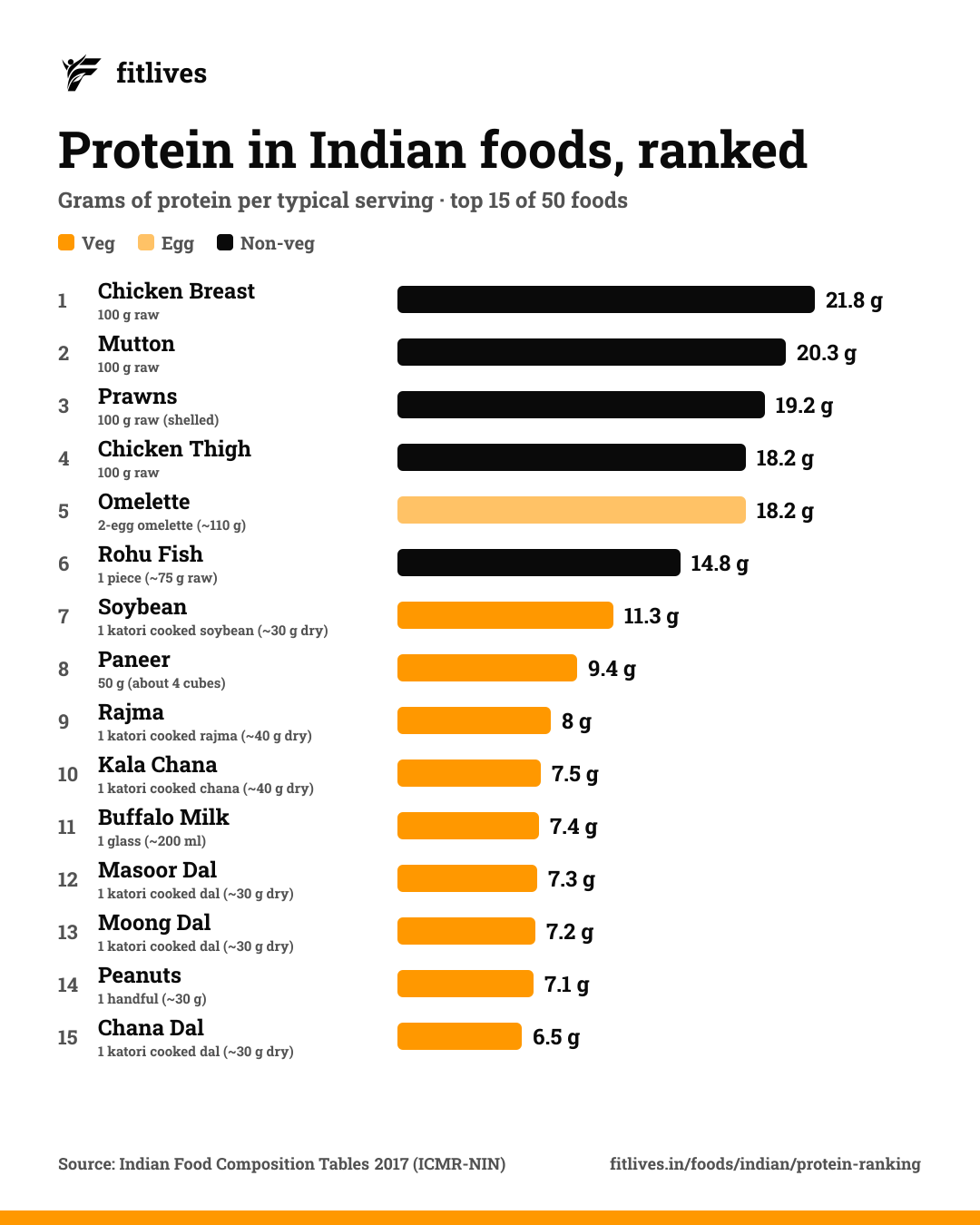
- Most protein per serving: chicken breast (21.8 g), mutton (20.3 g), prawns (19.2 g).
- Best vegetarian sources per serving: soybean (11.3 g), paneer (9.4 g), rajma (8 g).
- Most protein per calorie: egg white (23.3 g), prawns (21.1 g), rohu fish (19.3 g) per 100 kcal.
The full ranking
50 foods ranked by protein per serving
| # | Food | Typical serving | Protein / serving | kcal / serving | Protein / 100 kcal | Protein / 100 g |
|---|---|---|---|---|---|---|
| 1 | Chicken BreastNon-veg | 100 g raw | 21.8 g | 168 | 13 g | 21.8 g |
| 2 | MuttonNon-veg | 100 g raw | 20.3 g | 188 | 10.8 g | 20.3 g |
| 3 | PrawnsNon-veg | 100 g raw (shelled) | 19.2 g | 91 | 21.1 g | 19.2 g |
| 4 | Chicken ThighNon-veg | 100 g raw | 18.2 g | 200 | 9.1 g | 18.2 g |
| 5 | OmeletteEgg | 2-egg omelette (≈110 g) | 18.2 g | 187 | 9.7 g | 16.5 g |
| 6 | Rohu FishNon-veg | 1 piece (≈75 g raw) | 14.8 g | 77 | 19.3 g | 19.7 g |
| 7 | SoybeanVeg | 1 katori cooked soybean (≈30 g dry) | 11.3 g | 113 | 10 g | 37.8 g |
| 8 | PaneerVeg | 50 g (about 4 cubes) | 9.4 g | 129 | 7.3 g | 18.9 g |
| 9 | RajmaVeg | 1 katori cooked rajma (≈40 g dry) | 8 g | 120 | 6.7 g | 19.9 g |
| 10 | Kala ChanaVeg | 1 katori cooked chana (≈40 g dry) | 7.5 g | 115 | 6.5 g | 18.8 g |
| 11 | Buffalo MilkVeg | 1 glass (≈200 ml) | 7.4 g | 214 | 3.4 g | 3.7 g |
| 12 | Masoor DalVeg | 1 katori cooked dal (≈30 g dry) | 7.3 g | 97 | 7.6 g | 24.4 g |
| 13 | Moong DalVeg | 1 katori cooked dal (≈30 g dry) | 7.2 g | 98 | 7.3 g | 23.9 g |
| 14 | PeanutsVeg | 1 handful (≈30 g) | 7.1 g | 156 | 4.5 g | 23.7 g |
| 15 | Chana DalVeg | 1 katori cooked dal (≈30 g dry) | 6.5 g | 99 | 6.6 g | 21.6 g |
| 16 | Cow MilkVeg | 1 glass (≈200 ml) | 6.5 g | 146 | 4.5 g | 3.3 g |
| 17 | Toor DalVeg | 1 katori cooked dal (≈30 g dry) | 6.5 g | 99 | 6.6 g | 21.7 g |
| 18 | Boiled EggEgg | 1 egg (≈45 g without shell) | 6 g | 67 | 9.1 g | 13.4 g |
| 19 | QuinoaVeg | 1 katori cooked quinoa (≈45 g dry) | 5.9 g | 148 | 4 g | 13.1 g |
| 20 | Green PeasVeg | 1 katori (≈80 g) | 5.8 g | 65 | 9 g | 7.3 g |
| 21 | Brown RiceVeg | 1 katori cooked rice (≈50 g raw) | 4.6 g | 177 | 2.6 g | 9.2 g |
| 22 | SujiVeg | 1 plate (≈40 g dry suji) | 4.6 g | 134 | 3.4 g | 11.4 g |
| 23 | BajraVeg | 1 roti (≈40 g bajra flour) | 4.4 g | 139 | 3.1 g | 11 g |
| 24 | DaliaVeg | 1 bowl (≈40 g dry dalia) | 4.3 g | 137 | 3.2 g | 10.8 g |
| 25 | JowarVeg | 1 roti / bhakri (≈40 g jowar flour) | 4 g | 134 | 3 g | 10 g |
| 26 | White RiceVeg | 1 katori cooked rice (≈50 g raw) | 4 g | 178 | 2.2 g | 7.9 g |
| 27 | Egg WhiteEgg | 1 egg white (≈30 g) | 3.7 g | 16 | 23.3 g | 12.4 g |
| 28 | PohaVeg | 1 plate (≈50 g dry poha) | 3.7 g | 177 | 2.1 g | 7.4 g |
| 29 | RotiVeg | 1 medium roti (30 g atta) | 3.2 g | 96 | 3.3 g | 10.6 g |
| 30 | Cashew NutsVeg | 10 cashews (≈15 g) | 2.8 g | 87 | 3.2 g | 18.8 g |
| 31 | KhoaVeg | 1 tablespoon (≈15 g) | 2.5 g | 47 | 5.2 g | 16.3 g |
| 32 | PotatoVeg | 1 medium potato (≈150 g) | 2.3 g | 105 | 2.2 g | 1.5 g |
| 33 | AlmondsVeg | 10 almonds (≈12 g) | 2.2 g | 73 | 3 g | 18.4 g |
| 34 | RagiVeg | 1 roti (≈30 g ragi flour) | 2.1 g | 96 | 2.2 g | 7.2 g |
| 35 | Sweet PotatoVeg | 1 medium sweet potato (≈130 g) | 1.7 g | 142 | 1.2 g | 1.3 g |
| 36 | GuavaVeg | 1 medium guava (≈100 g) | 1.4 g | 32 | 4.5 g | 1.4 g |
| 37 | PomegranateVeg | 1 katori seeds (≈100 g) | 1.3 g | 55 | 2.4 g | 1.3 g |
| 38 | BananaVeg | 1 medium banana (≈100 g peeled) | 1.2 g | 105 | 1.2 g | 1.2 g |
| 39 | MurmuraVeg | 1 cup (≈15 g) | 1.1 g | 54 | 2.1 g | 7.5 g |
| 40 | OrangeVeg | 1 medium orange (≈130 g segments) | 0.9 g | 48 | 1.9 g | 0.7 g |
| 41 | WatermelonVeg | 1 katori cubes (≈150 g) | 0.9 g | 30 | 3 g | 0.6 g |
| 42 | MangoVeg | 1 katori sliced mango (≈150 g) | 0.8 g | 83 | 1 g | 0.5 g |
| 43 | WalnutsVeg | 1 walnut (2 halves, ≈5 g) | 0.7 g | 34 | 2.2 g | 14.9 g |
| 44 | GrapesVeg | 1 katori (≈100 g) | 0.6 g | 54 | 1.1 g | 0.6 g |
| 45 | PapayaVeg | 1 katori papaya cubes (≈150 g) | 0.6 g | 36 | 1.7 g | 0.4 g |
| 46 | SpinachVeg | 1 cup raw leaves (≈30 g) | 0.6 g | 7 | 8.9 g | 2.1 g |
| 47 | AppleVeg | 1 medium apple (≈150 g) | 0.4 g | 93 | 0.5 g | 0.3 g |
| 48 | DatesVeg | 1 date (≈8 g) | 0.2 g | 25 | 0.8 g | 2.4 g |
| 49 | JaggeryVeg | 1 small piece (≈10 g) | 0.2 g | 35 | 0.5 g | 1.9 g |
| 50 | GheeVeg | 1 teaspoon (≈5 g) | 0 g | 44 | 0 g | 0 g |
Top 10 vegetarian protein foods per serving
- Soybean — 11.3 g in 1 katori cooked soybean (≈30 g dry) (113 kcal)
- Paneer — 9.4 g in 50 g (about 4 cubes) (129 kcal)
- Rajma — 8 g in 1 katori cooked rajma (≈40 g dry) (120 kcal)
- Kala Chana — 7.5 g in 1 katori cooked chana (≈40 g dry) (115 kcal)
- Buffalo Milk — 7.4 g in 1 glass (≈200 ml) (214 kcal)
- Masoor Dal — 7.3 g in 1 katori cooked dal (≈30 g dry) (97 kcal)
- Moong Dal — 7.2 g in 1 katori cooked dal (≈30 g dry) (98 kcal)
- Peanuts — 7.1 g in 1 handful (≈30 g) (156 kcal)
- Chana Dal — 6.5 g in 1 katori cooked dal (≈30 g dry) (99 kcal)
- Cow Milk — 6.5 g in 1 glass (≈200 ml) (146 kcal)
Share the infographic
Free to use on your website, blog or gym notice board — please link back to this page as the source.
<a href="https://fitlives.in/foods/indian/protein-ranking" title="Protein in Indian foods, ranked — fitlives">
  <img src="https://fitlives.in/foods/indian/protein-ranking/infographic.png" alt="Protein in Indian foods ranked per serving (IFCT 2017 data)" width="1080" height="1350" loading="lazy" style="max-width:100%;height:auto" />
</a>
<p>Source: <a href="https://fitlives.in/foods/indian/protein-ranking">Protein in Indian foods, ranked — fitlives</a></p>fitlives. "Protein in Indian Foods, Ranked." https://fitlives.in/foods/indian/protein-ranking (data: ICMR-NIN Indian Food Composition Tables 2017).How to read this ranking
Per serving is the most practical view: it shows what a normal portion — a katori of dal, a glass of milk, 50 g of paneer — actually contributes to your day.
Per 100 kcal shows protein density. High numbers mean you get a lot of protein without many calories, which helps most when you're in a calorie deficit. Some vegetables score well here but are eaten in such small amounts that they add little protein in practice.
Per 100 g matches food labels and nutrition tables. Dals, grains and soybean are listed by dry (raw) weight, so 100 g dry dal cooks into roughly three katoris.
Plant proteins are lower in some essential amino acids than animal proteins; combining dal or rajma with grains, and adding dairy or soya, covers the gap over a day. See the best high-protein Indian foods for meal ideas.
Method and source
Protein and calories per 100 g come from the Indian Food Composition Tables 2017 (ICMR–National Institute of Nutrition). Serving sizes are typical Indian portions shown on each food's page; per-serving values are scaled from the 100 g figures and rounded to one decimal. The ranking updates automatically when foods are added or corrected.
Educational information only. Nutrient values vary by variety, recipe and cooking method. Medical disclaimer.